

Long read based Genome Assembly
A) Importance and Applications of Long-Read Genome Assembly
Previous short-read-based genome assembly had a limitation in that short read lengths (tens to hundreds of bp) made alignment and assembly difficult in repetitive sequences or complex genomic regions. As a result, genomes were often assembled in a fragmented manner, or important regions were missed. In contrast, long-read sequencing technologies (such as PacBio and Oxford Nanopore) can generate long reads extending from several kb to tens of kb, allowing for the alignment of entire repetitive sections (Figure 1). This reduces gaps in the assembly process and enables more accurate reconstruction of the genome structure.
A representative case is the project that completely sequenced the human genome from telomere-to-telomere (T2T), which clearly demonstrates the advantages of long-read technology. Furthermore, long-read-based assembly is being used as a core tool in advanced genome research for major crops and livestock.
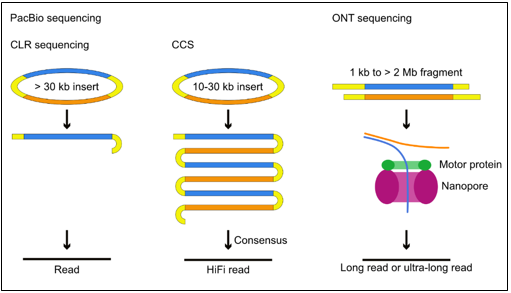
B) Long-Read-Based Genome Assembly Methods
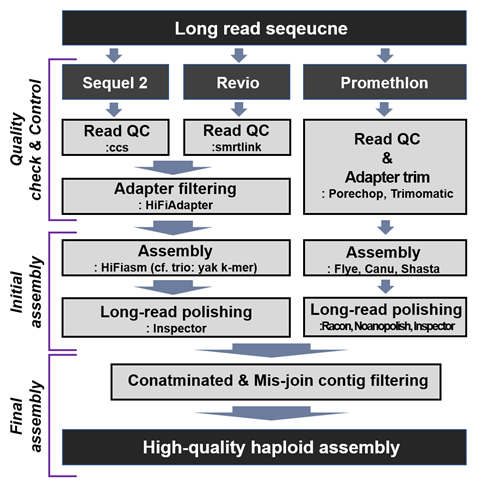
To obtain genetic variants, we used various bioinformatics software and followed a sequence of steps: quality control and trimming > initial assembly > final assembly (Figure 2). Additionally, using the completed assembly, we constructed a pangenome following the method of minigraph-cactus (github).
-
Long-Read Data Quality Control (Read QC)
A representative case is the project that completely sequenced the human genome from telomere-to-telomere (T2T), which clearly demonstrates the advantages of long-read technology. Furthermore, long-read-based assembly is being used as a core tool in advanced genome research for major crops and livestock.
bashccs input.bam output.ccs.bam porechop -i KPR_ont_reads.fastq -o KPR_ont_trimmed.fastq -
Adapter filtering/trim
For PacBio data, residual adapter sequences were removed using HiFiAdapter. For ONT data, adapter trimming was already applied during the preceding QC step.
bashhifiadapterfilt —in KPR_input.ccs.fastq —out KPR_filtered.fastq -
Initial assembly
An initial assembly was performed using platform-specific assemblers. For PacBio HiFi reads, assembly was conducted using HiFiasm. For ONT PromethION reads, which have a higher error rate, assemblers such as Flye, Canu, Shasta were applied.
bashhifiasm \ -o KPR.asm \ --dual-scaf \ --telo-m CCCTAA \ --h1 KPR_read1.fq.gz \ --h2 KPR_read2.fq.gz \ --ul KPR_ul.fq.gz \ KPR-HiFi.fq.gz flye \ --nano-raw KPR_ont_trimmed.fastq \ --out-dir KPR_flye_out \ --genome-size 3g \ --threads 32 canu \ -p asm \ -d KPR_canu_out \ genomeSize=3g \ -nanopore-raw KPR_ont_trimmed.fastq \ useGrid=false \ maxThreads=32 shasta \ --input KPR_ont_trimmed.fastq \ --assemblyDirectory shasta_out \ --threads 32 -
Long-read polishing
The initial assembly result underwent a polishing process for error correction. For PacBio, residual errors were corrected using Inspector. For ONT reads, a multi-step polishing was performed by combining tools like Racon, Nanopolish, and Inspector.
bashracon KPR_ont_reads.fastq KPR_ont_aln.sam flye_out/KPR_assembly.fasta > racon_KPR_polished.fasta nanopolish variants --consensus polished.fa \ --reads KPR_ont_trimmed.fastq \ --bam KPR_aln.sorted.bam \ --genome flye_out/assembly.fasta \ --threads 32 inspector -i KPR_output.asm.p_ctg.fa -b KPR_aln.bam -o KPR_inspector_out -
Contaminated & mis-join contig filtering
-
Contamination detection
Assembly results often contain external contaminant sequences or mis-joined contigs. Since these can cause fatal errors in downstream analysis, a filtering process was performed.
bashblobtools create --fasta KPR_assembly.fasta --bam KPR_aln.sorted.bam --taxid-mapping taxdump kraken2 --db kraken_db --threads 32 --output KPR_kraken.out --report KPR_kraken.report assembly.fasta -
Mis-join contig detection
We verified the quality of the genome assembly using several tools. We used QUAST to quantitatively evaluate the assembly quality with metrics like N50 and mis-assembly rate by comparing it to a reference genome. Additionally, we used Inspector or Tigmint to align long-read or linked-read data and find regions with abnormal read support. Finally, we utilized Hi-C data along with 3D-DNA or Juicer to identify and correct chromosome-scale mis-joins.
bashquast.py KPR_assembly.fasta -r reference.fa -o quast_out tigmint-make tigmint draft=assembly reads=KPR_ont_trimmed.fastq juicer.sh -d juicer_out -D /path/to/juicer_tools -z KPR_assembly.fasta -p chrom.sizes -s MboI run-asm-pipeline.sh KPR_assembly.fasta juicer_out/aligned/KPR_merged_nodups.txt
-
Contamination detection
-
Construction of the Pangenome
-
Preparing the Input Seqfile
First, prepare the assembled fasta files from the previous steps. Create a Seqfile by entering the sample's structure as follows (using KPR's KOR-101 sample as an example).
bashKOR-101.1 paternal.fa KOR-101.2 maternal.fa CHM13.0 chm13.fa GRCh38 grch38.fa -
Fixing problem contigs
Use commands such as the following to ensure all contigs are in the same format.
bashwget -q $(grep KOR-102\.1 KPR-mc.seqfile | tail -1 | awk '{print $2}') -O KOR-102.1.fa.gz gzip -d KOR-102.1.fa.gz samtools faidx KOR-102.1.fa -
Adding the Y-chromosome to the CHM13 reference used together
Since CHM13 lacks chrY, we add chrY. Next, we also update the Seqfile.
bashwget -q $(grep CHM13 KPR-mc.seqfile | tail -1 | awk '{print $2}') -O CHM13.Y.v1.1.fa.gz wget -q $(grep GRCh38 KPR-mc.seqfile | tail -1 | awk '{print $2}') -O GRCh38.fa.gz gzip -d GRCh38.fa.gz samtools faidx GRCh38.fa chrY chrEBV | bgzip --threads 8 >> CHM13.Y.KPR.fa.gz aws s3 cp CHM13.Y.KPR.fa.gz ${MYBUCKET}/fasta/ grep -v CHM13 KPR-mc.seqfile > t printf "CHM13_1_1\t${MYBUCKET}/fasta/CHM13.Y.KPR.fa.gz\n" > KPR-mc.seqfile cat t >> KPR-mc.seqfile -
Standardizing Contig Naming Rules
Using cactus-preprocess, we corrected the contigs to the SAMPLE.HAPLOTYPE#CONTIG naming convention.
bashcactus-preprocess ${MYJOBSTORE} KPR-mc.seqfile KPR-mc.pp.seqfile \ --configFile ./config_cut_hash.xml --realTimeLogging \ --batchSystem mesos --provisioner aws --defaultPreemptable \ --nodeType r5.8xlarge --nodeStorage 500 --maxNodes 2 \ --skipMasking --logFile KPR-mc-grch38.pp.log -
Construction of Pangenome
A pangenome was constructed by generating a minigraph using cactus-minigraph.
bashcactus-minigraph "${MYJOBSTORE}" KPR-mc.pp.seqfile \ "${MYBUCKET}/KPR-minigraph-grch38.gfa.gz" \ --reference GRCh38 \ --realTimeLogging \ --batchSystem mesos --provisioner aws --defaultPreemptable \ --nodeType r5.8xlarge:1.5 --nodeStorage 650 --maxNodes 25 \ --betaInertia 0 --targetTime 1 \ --logFile KPR-minigraph-grch38.log
-
Preparing the Input Seqfile
C) Application of the Pangenome in Subsequent Research
-
Population and Evolutionary Studies
Utilizing a pangenome allows for a comprehensive exploration of structural and rare variants across different populations, which can reveal unique genetic characteristics of specific demographics. Additionally, by conducting comparative studies between species from a phylogenetic and evolutionary perspective, it can contribute to understanding the evolutionary history and adaptation processes of the human genome. Notably, since the pangenome built in this project includes a Korean sample, it can be directly applied to population genetics research specific to Koreans.
-
Clinical and Disease Research
Clinically, a pangenome can enhance the accuracy of molecular diagnoses for rare diseases by capturing variants that are difficult to find with conventional single-reference-based analysis. In cancer research, it can contribute to understanding disease mechanisms and discovering new therapeutic targets by precisely identifying tumor-specific structural variations, copy number variations (CNVs), and rearrangement patterns. Furthermore, pangenome analysis that reflects diverse ethnicities is expected to enable research on ethnicity-specific diseases.
Reference
-
Lim J. (2023) Long-Read Sequencing Technologies for the Human Genome and Their Applications. BRIC View.
https://www.ibric.org/s.do?FkMxhOvTOQ