

Securing Genetic Variation Data Based on Long-Read Sequencing
A) Significance of Securing Genetic Variation from Long-Reads
-
Precision Diagnostics and Therapeutic Target Discovery
By sufficiently securing genetic variations at the individual and population levels, it is possible to more accurately distinguish between pathogenic (causal) variants and passenger variants. Genetic variations can be broadly divided into Single Nucleotide Polymorphisms (SNPs) and Structural Variants (SVs). SNPs are small-scale changes at the single-nucleotide level that occur frequently, with a frequency of about one in every 1,000 base pairs. They are widely utilized in population comparisons, disease association studies, and drug response research. SVs include large-scale insertions, deletions, inversions, and translocations of 50 bp or more. They are called structural variants (SVs) and hold significant pathological importance because they greatly affect not only protein-coding regions but also regulatory regions. These variants can cause loss of gene function or expression imbalances, potentially having a more critical impact on disease. Both SNPs and SVs serve as the core basis for disease association analysis and targeted drug development. Based on this, they are applied in precision medicine as biomarkers and therapeutic targets.
-
Advantages of Long-Read Analysis
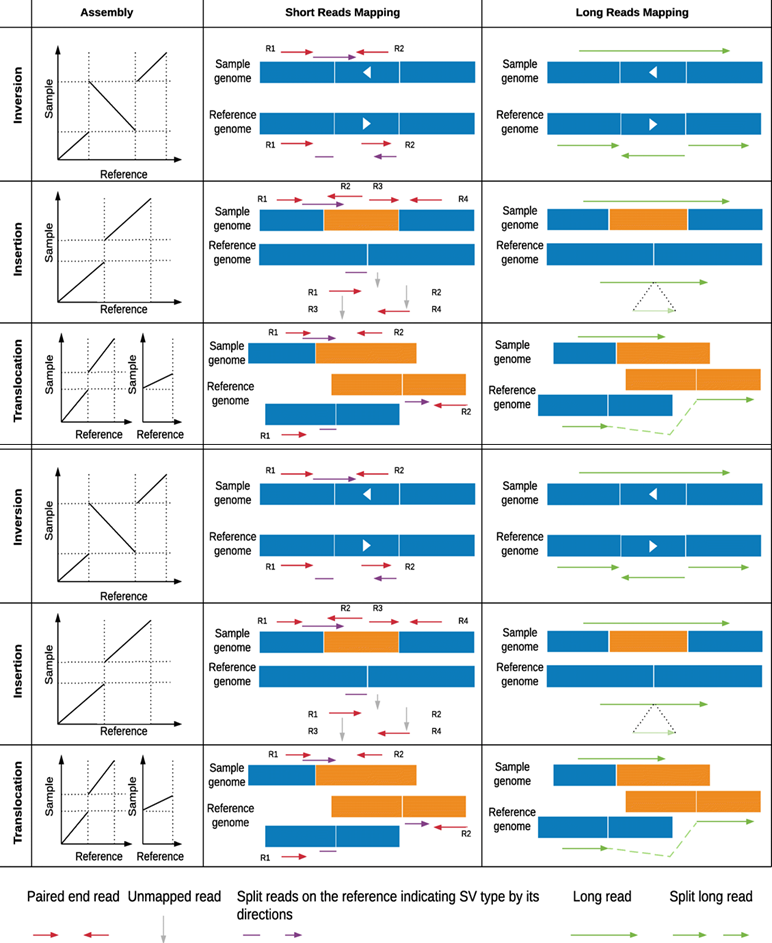
Short reads have difficulty handling repetitive sequences and long variants due to their short read length. This limits their ability to detect large-scale insertions, deletions, inversions, and translocations. In contrast, long reads (ONT, PacBio) can directly read continuous sequences that are several kb to tens of kb long, allowing for stable alignment where a single read spans an entire repetitive region. Specifically, long reads can directly detect large-scale variants like insertions and deletions, confirm structural rearrangements like inversions and translocations at the read level, and distinguish parental alleles (haplotyping) within a single read. Thanks to these advantages, long reads can uncover more variants than short reads, and they are especially excellent for analyzing large-scale structural variants, which are clinically important (Fig. 3). Consequently, they are being used as a core tool in various fields, including complex disease research, rare disease diagnosis, and pangenome construction.
B) Genetic Variation Identification Method
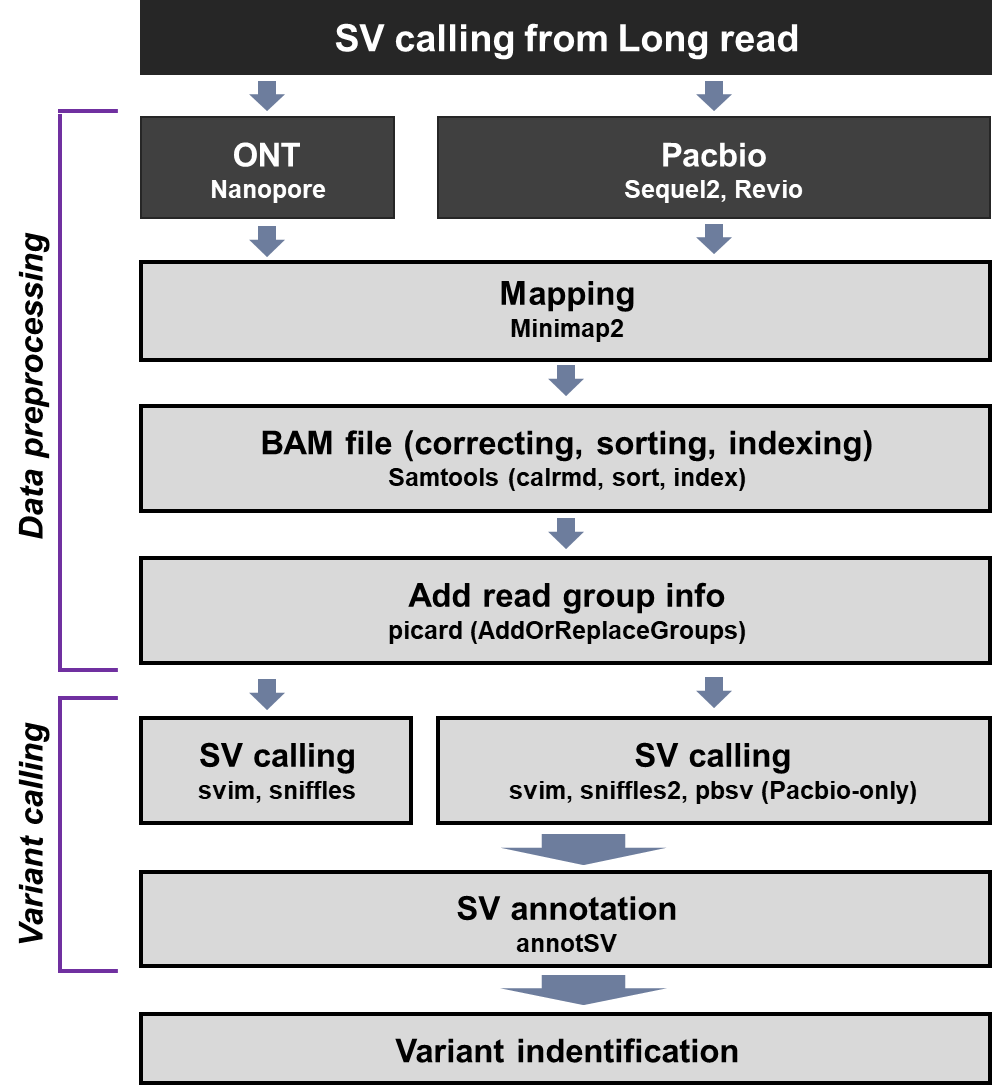
To identify genetic variations, various bioinformatics software tools were used. The process was conducted in the following sequence: Quality Control > Alignment > Data Correction and Formatting > Variant Calling (Figure 4).
-
Quality Control of Long-Read Sequences
In this study, FastQC was utilized to inspect the quality of both ONT and PacBio long-read data. FastQC provides a visualized report that includes per-base quality distribution, GC content, read length distribution, duplication levels, and the presence of adapter sequences. For this research, a Phred score of 30 was established as the quality threshold (Figure 5).
bashfastqc sample.fastq.gz -o platform_qc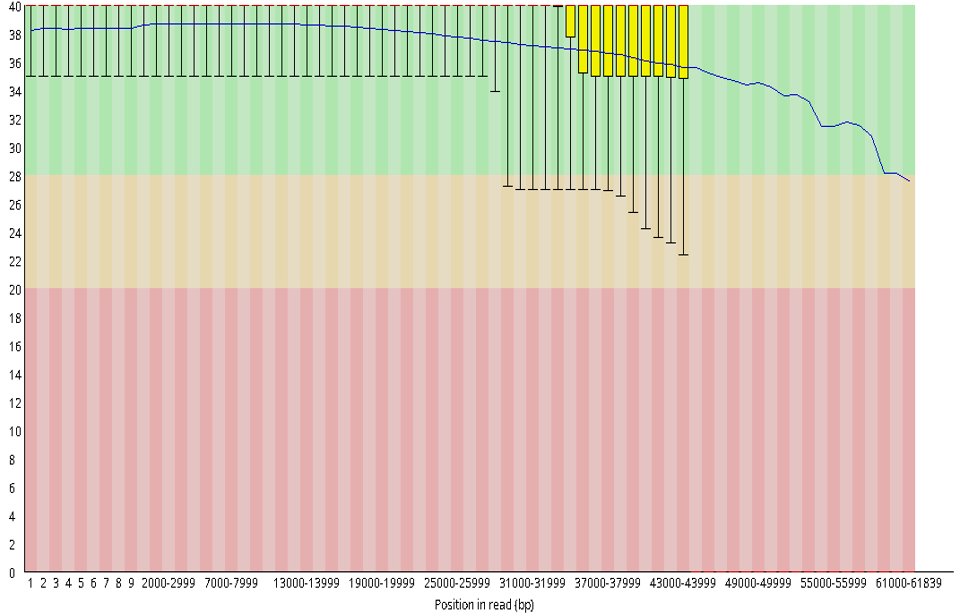
Figure 5. Example of FastQC results -
Alignment of ONT Ultra-Long-Reads
When aligning ONT reads to a reference genome, the -x map-ont option is used to perform mapping that is specifically tailored to the characteristics of ONT data. The -a flag specifies that the results should be output in SAM format.
bashminimap2 -ax map-ont reference.fa KPR_ont_reads.fastq > KPR_ont_aln.sam -
Alignment of PacBio HiFi Reads
For aligning PacBio HiFi reads, the -x map-pb option is used to map in a mode dedicated to HiFi data. Similarly, the -a flag is used to output the results in SAM format.
bashminimap2 -ax map-pb reference.fa KPR_pb_reads.fastq > KPR_pb_aln.sam -
SAM → BAM Conversion and Sorting
The SAM file is converted to the binary BAM format (view -bS) and then sorted by coordinate (sort) to enable efficient downstream analysis.
bashsamtools view -bS KPR_aln.sam | samtools sort –o KPR_aln.sorted.bam -
CIGAR / MD Tag Correction
The calmd option is used to correct mismatch information (the MD tag and NM field) based on the reference sequence.
bashsamtools calmd -b KPR_aln.sorted.bam reference.fa > KPR_aln.calmd.bam -
BAM file indexing
Creating an index for a BAM file allows for faster access to specific regions.
bashsamtools index KPR_aln.calmd.bam -
Adding Read Group Information to the BAM Header
Essential read group metadata, which is required by many variant calling tools, is added. Here, RGPL specifies the platform used (e.g., ONT, PacBio), and RGSM is used for the sample name.
bashpicard AddOrRxeplaceReadGroups I=KPR_aln.calmd.bam O=KPR_aln.rg.bam RGID=sample RGLB=lib1 RGPL=ONT RGSM=sample_name -
Sniffles2 SV calling (ultra-long-read)
Sniffles2 is used to detect structural variants from long-reads and the results are saved in VCF format.
bashsniffles --input KPR_aln.rg.bam —vcf KPR_sniffles.vcf -
SVIM SV calling (ultra-long-read)
An alternative method of structural variant detection is performed using SVIM, and the results are saved to the specified output directory.
bashsvim alignment KPR_svim_out_dir reference.fa KPR_aln.rg.bam -
pbsv (PacBio-specific SV calling)
Structural variants are detected using pbsv, a tool specialized for PacBio HiFi reads. Signatures are extracted in the discover step, and the final VCF is generated in the call step.
bashpbsv discover KPR_aln.rg.bam KPR_sample.svsig.gz pbsv call reference.fa KPR_sample.svsig.gz KPR_pbsv.vcf -
VCF File Merging
SURVIVOR is used to merge the results from multiple SV callers. In this process, variants within 100 bp of each other are considered the same event, and the minimum allowed length is set to 50 bp.
bashSURVIVOR merge KPR_file_list.txt 100 1 1 0 0 50 KPR_merged.vcf -
SV annotation
Using AnnotSV, the merged variants are annotated with information regarding genes, regulatory regions, and clinical relevance.
bashAnnotSV -SVinputFile KPR_merged.vcf -genomeBuild GRCh38 -outputFile KPR_annotated.tsv
C) Application of Genetic Variants in this study
-
Comparison with Short-Read Variants
Long-read and short-read sequencing each possess distinct advantages, showing significant differences, particularly in their capability to detect structural variants (SVs). In this study, we co-analyze short-read data generated from the same sample to quantitatively compare whether a greater number of structural variants are indeed detected by long-read sequencing.
During this process, we will compare the detection frequencies categorized by variant type (e.g., insertion, deletion, inversion, translocation). We will also specifically analyze the characteristics (e.g., repetitive sequences, GC-rich regions) of additional variants that went undetected by short-reads but were uniquely identified with long-reads. Through this approach, we aim to quantitatively substantiate the superiority of long-read sequencing for variant discovery and address the limitations of short-read-based variant analysis.
-
Benchmarking of Pangenome Variants
While long-read sequencing is known to detect more variants compared to short-read sequencing, the pangenome possesses the unique characteristic of reflecting ethnic diversity. Research suggests that, as a result, an even greater number of variants can be detected.
Therefore, this study will utilize the variants discovered from the Korean pangenome we constructed for benchmarking purposes. We will assess the extent of similarity between these pangenome-derived variants and those called from long-reads. This process will also be used to determine how many novel variants were newly identified specifically from the pangenome.
-
Application in Disease Research
Rare diseases are often caused by large-scale structural variations or complex gene rearrangements. However, these types of variants are easily missed in short-read-based analyses. The long-read variant information obtained in this study can be directly utilized to identify pathogenic variants in cohorts of rare disease patients—variants that were not discovered with conventional short-read methods.
Furthermore, by securing Korean population-specific variants through pangenome analysis, it becomes possible to compare differences in the incidence and genetic background of rare diseases with other ethnic groups. The genetic variations discovered from long-reads will serve as crucial foundational data for identifying causal genes and improving diagnostic accuracy for Korean patients with rare diseases.
Reference
-
Mahmoud, M., Gobet, N., Cruz-Dávalos, D. I., Mounier, N., Dessimoz, C., & Sedlazeck, F. J. (2019). Structural variant calling: the long and the short of it. Genome Biology, 20(1), 246.
https://link.springer.com/article/10.1186/s13059-019-1828-7